The plazas
Military Plaza and Haymarket as working food spaces, and what replaced them.
San Antonio's open-air kitchens, and what the city eventually put in their place
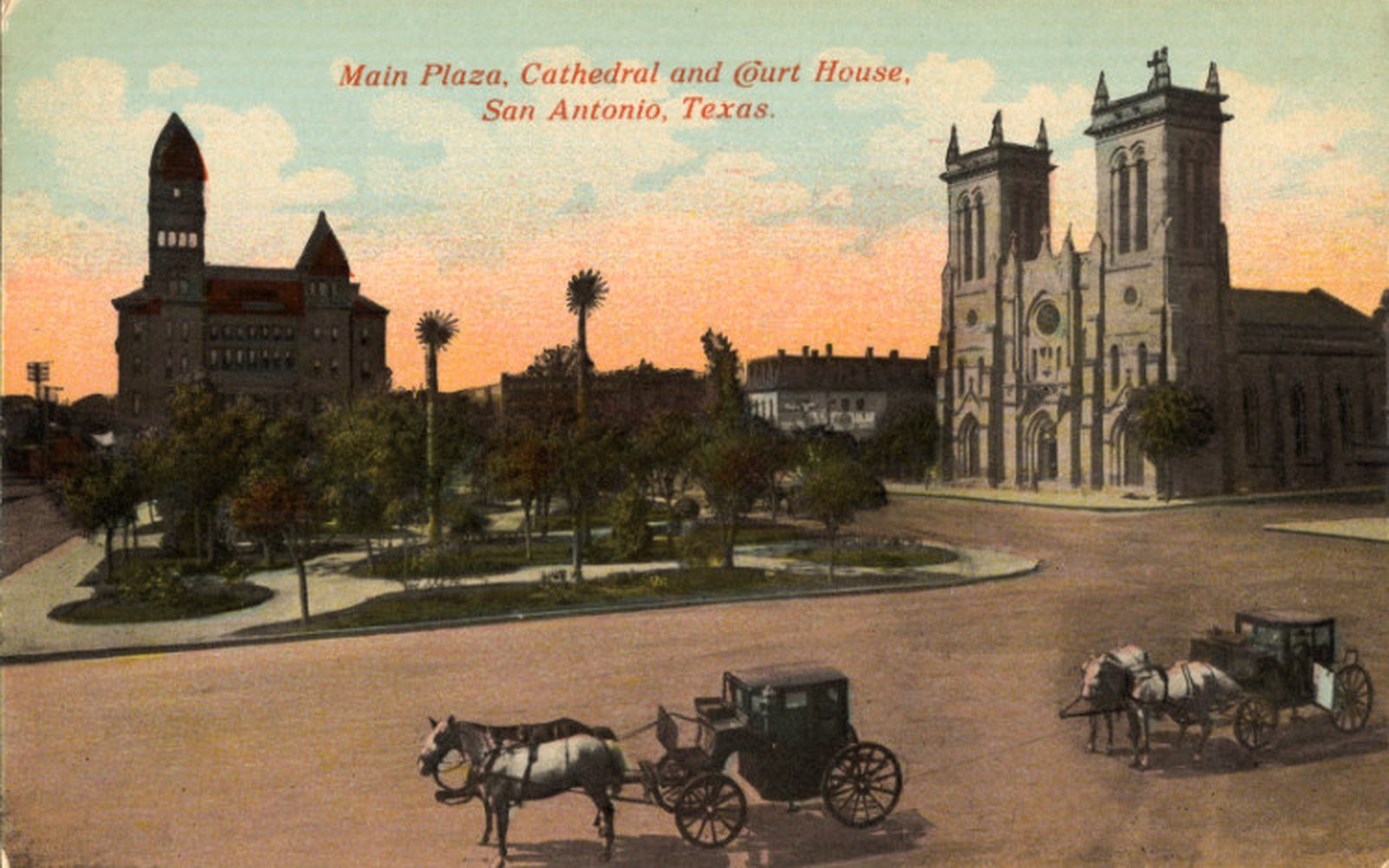
San Antonio had two plazas that mattered most to its street food history: Military Plaza, the old Plaza de Armas, and Haymarket Plaza to its west. Both were working spaces — not decorative squares but hard-packed ground where commerce happened every day, and where food came to the people who needed it.
Military Plaza was the older and grander of the two. Laid out during the Spanish colonial period, it sat at the civic heart of San Antonio, flanked by the city hall and close to the San Fernando Cathedral. Through most of the nineteenth century it hosted a sprawling open-air market: produce vendors, hay and feed sellers, woodcutters with cords stacked on wagons, and — by the 1860s at the latest — the women who would become famous as the Chili Queens. They set up trestles and clay pots at nightfall, lit kerosene lamps, and served chili con carne, tamales, and coffee to anyone who came with a few cents. The clientele was genuinely mixed: laborers, soldiers from the nearby garrison, merchants, and, by the 1880s and 1890s, tourists who had read about the Queens in national newspapers and arrived expecting a spectacle. The food was not the spectacle — it was the point — but the two things became tangled together in outside coverage that the sellers themselves never controlled.
The daytime plaza was already busy before the evening trade began. Ranchers drove livestock through. Cotton and corn changed hands. The whole space operated as the city's unofficial distribution hub, which is why food vendors could sustain a nightly business there: the foot traffic was already built in. By the time San Antonio's population was climbing sharply in the last decades of the nineteenth century, Military Plaza on a busy evening held dozens of stands, each run by a woman who managed her own fire, her own stock, and her own cash.
 PL. 04
Haymarket Plaza absorbed some of that energy when the city began to reshape Military Plaza in the 1880s. The construction of a new city hall building directly on the old plaza ground displaced vendors and changed the character of the space permanently. Haymarket, a few blocks west, became the produce and wholesale market — the place where the vendors who fed the city sourced what they needed. It was a utilitarian space, louder and less romanticised than Military Plaza had been in its heyday, but commercially essential. The two plazas functioned as linked infrastructure: one the point of retail sale, one the supply chain behind it.
What replaced them was the logic of the enclosed, regulated city. San Antonio's public health authorities, operating under the same Progressive-era assumptions that were reorganizing street markets across American cities in the early twentieth century, moved against the open-air food trade on hygiene grounds. The specific ordinances targeting the Chili Queens' stands required screened enclosures, inspected equipment, and conditions that a trestle-and-clay-pot operation could not practically meet. The Queens were pushed from Military Plaza to Haymarket, then to a dedicated enclosure in Haymarket, and the trade shrank at each move. By 1943 the last permitted stands had been closed.
The plazas themselves did not disappear, but their function did. Military Plaza is today a landscaped civic space adjacent to San Antonio's city hall — clean, maintained, historically marked, and used primarily as a through-route. Haymarket became the site of a covered municipal market building, and later a parking facility. The wholesale produce function that once animated it moved to purpose-built distribution infrastructure outside the old city core.
What the plazas had provided was more than food. They were the organizing geography of a community that cooked in public, sold in public, and built a kitchen tradition in plain view of the city around them. The technique and the recipes did not disappear when the stands did — they moved indoors, into family kitchens and then into the restaurants that formalized Tejano cooking through the middle of the twentieth century. But the specific form of that economy, women working an open fire in a public square for a mixed crowd, existed precisely because the plazas existed. When the space changed, the form went with it.
 PL. 03