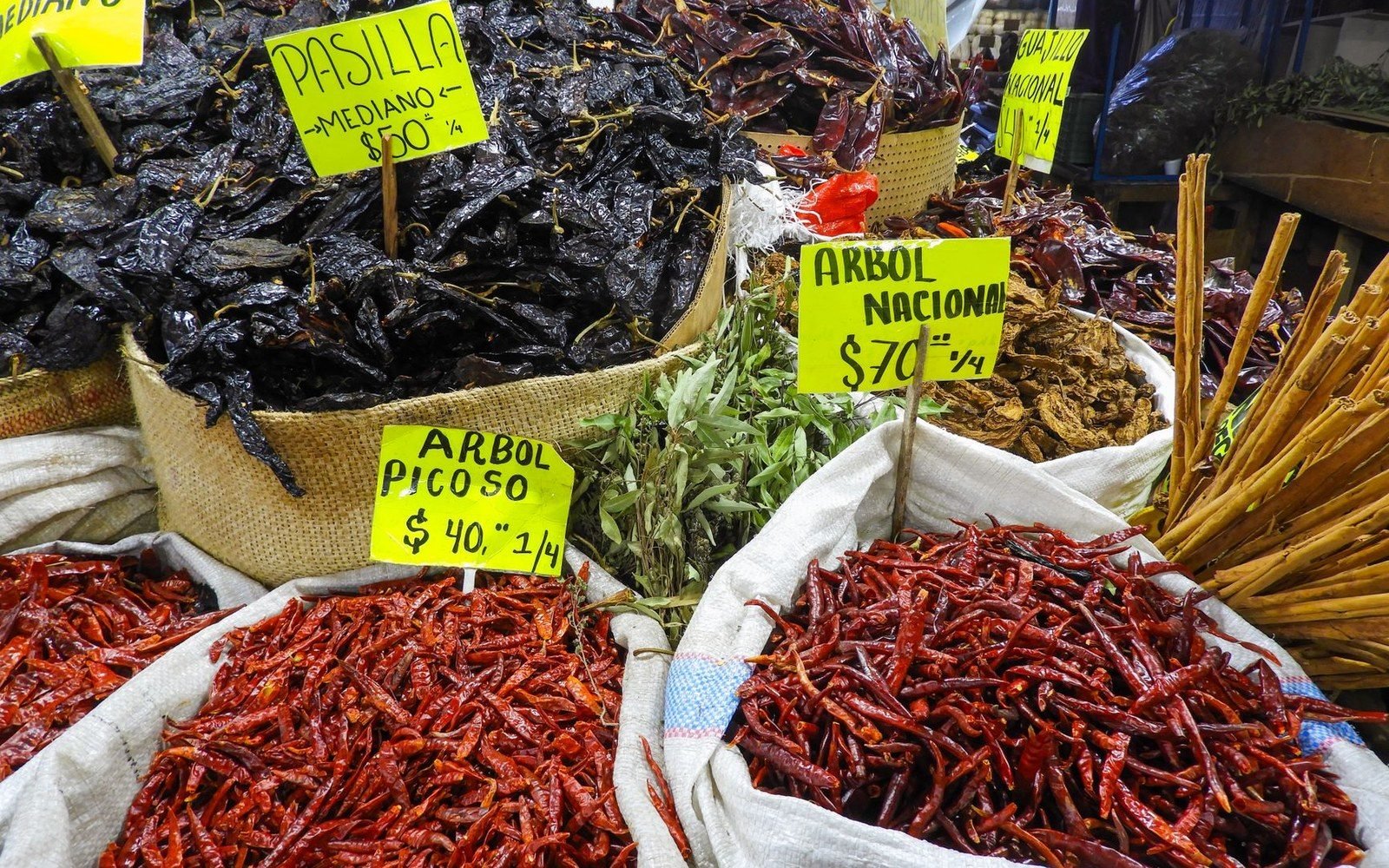
Dried chiles
Three chiles — ancho, guajillo, pasilla — carry the flavour of the red sauce, not the heat.
What drying does, and what you do next
A fresh poblano and a dried ancho are the same chile at different moments of its life. Drying concentrates sugars and deepens colour; it also creates new aromatic compounds that were not there in the fresh fruit. The result is less a preserved vegetable than a different ingredient entirely — earthier, more complex, with a flavour that no amount of fresh chile can replicate.
Ancho (dried poblano) is the widest and darkest of the three: a deep burgundy, almost black, with a raisin-and-chocolate note and mild heat. Guajillo is brick-red, thin-skinned, and carries a sharper, slightly tannic brightness — it gives sauces their colour as much as their flavour. Pasilla is long and near-black, with a dried-fruit depth that tends toward bitterness without the sweetness of the ancho. Used together, they balance each other; used alone, each pushes a sauce in a different direction.
 PL. 04
Toasting comes first. A dry comal — the flat griddle central to this kitchen — presses the chile flat for twenty or thirty seconds a side, until the skin blisters slightly and the kitchen fills with a roasted, almost smoky smell. Go a few seconds too far and the oils char; bitterness overtakes everything. The window is narrow. After toasting, the chiles go into just-boiled water for fifteen to thirty minutes. Soaking softens the flesh and allows the skin, which would otherwise stay tough and fibrous, to hydrate fully. The soaking liquid holds flavour too — used carefully, it deepens a sauce; used carelessly, with bitter or over-toasted chiles, it ruins one.
These three chiles are the backbone of the red sauces that define much of what chili gravy became when Tejano cooks moved into restaurant kitchens and built a dish that could scale. The technique did not simplify in that transition — toasting and soaking remained, because no shortcut produces the same result.
 PL. 03