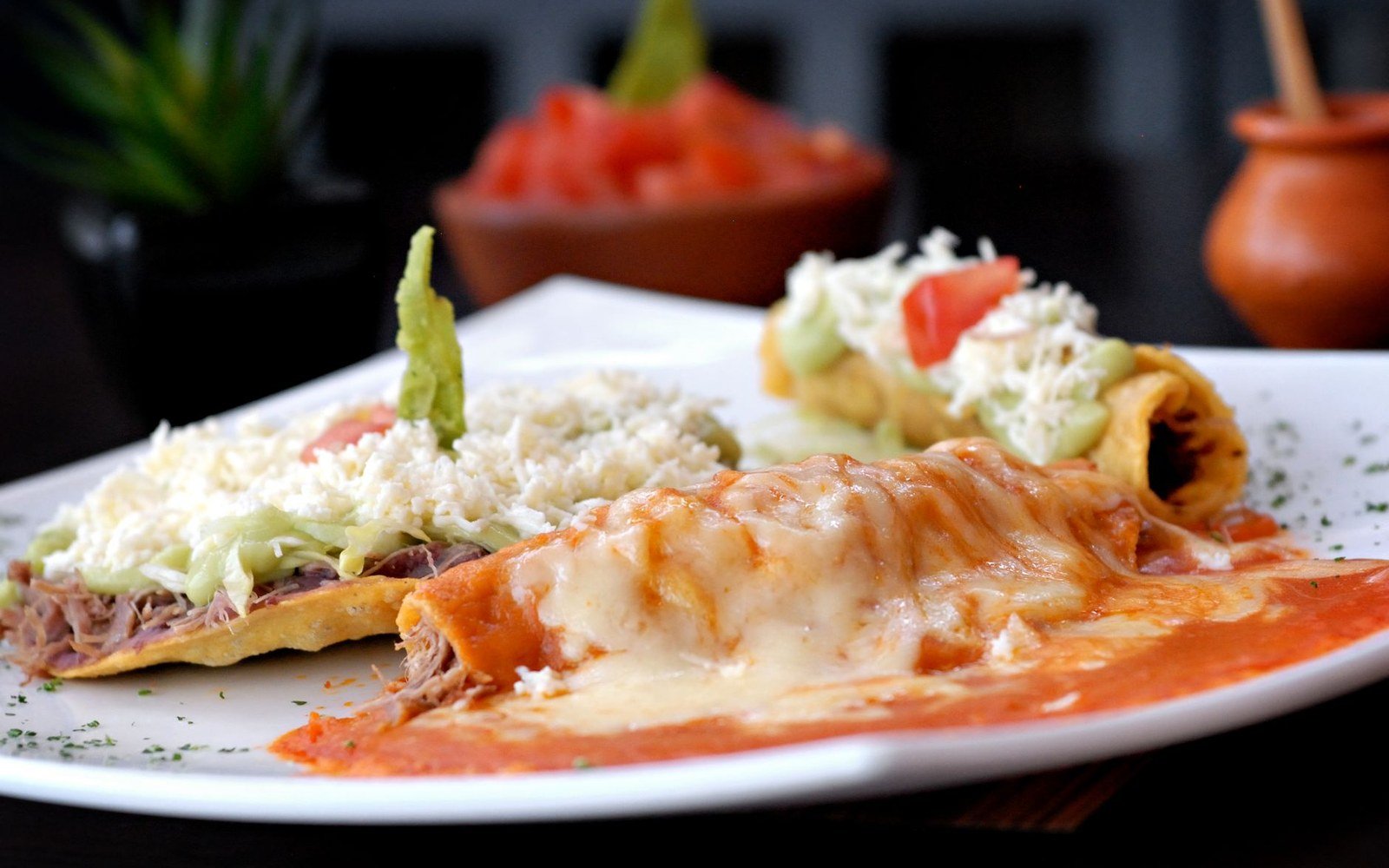
Chili gravy
A roux-thickened gravy that no Mexican regional kitchen makes, and the plate of enchiladas built around it.
The sauce that built the combination plate
Chili gravy is not a salsa, not a mole, and not a red enchilada sauce in any Mexican regional sense. It is a roux-thickened gravy — fat and flour cooked together first, then loosened with broth and seasoned with dried chile powder and cumin — and it belongs entirely to the Tex-Mex kitchen. No Mexican state produces it. It is the product of a specific border pantry working with specific constraints, and it shows.
The technique is pure American South: making a roux before building a sauce is the logic of cream gravy and country gravy, carried into a kitchen that already had chiles and comino on the shelf. The result is a sauce that behaves like a gravy — it coats, it holds heat, it thickens to a particular silky weight — but smells unmistakably of toasted cumin and the mild, dark earthiness of dried red chile. Lard was traditionally the fat, which gave the roux both flavour and the right texture for the broth to absorb into; shortening or oil work, but something flattens without the lard.
The chile component is powder, not whole dried pods reconstituted and blended. That is an important distinction. Mexican red sauces built from ancho or guajillo involve soaking, seeding, and pureeing whole chiles into something with more texture and a more complex, fruit-layered bitterness. Chili gravy uses ground dried red chile — the same pantry staple that went into chili con carne — which distributes evenly through the roux and gives a cleaner, more uniform colour. The sauce reads as red-brown rather than the deep brick or near-black of a mole-adjacent sauce.
 PL. 04
The enchilada plate it was made for
Chili gravy exists because of enchiladas, and specifically because of the version of enchiladas that became standard on the Tex-Mex combination plate through the early twentieth century. Corn tortillas — softened briefly in hot oil so they bend without cracking — are rolled around a filling of seasoned ground beef or shredded beef, sometimes with onion and yellow processed cheese inside, then laid in a baking dish and flooded with chili gravy. More cheese goes over the top, the whole pan goes under heat until the cheese melts and the gravy tightens slightly against the tortillas, and what comes out is genuinely its own thing: not a Mexican enchilada, not approximated Mexican food, but a Tex-Mex dish with its own internal logic and its own pleasures.
The yellow processed cheese matters here for the same reason it matters across Tex-Mex cooking: it melts without breaking. A fresh white cheese or a grated aged cheddar would either stay firm or weep fat. The processed cheese blends smoothly into the gravy at the edges of the pan, which is partly why the whole dish has that characteristic unified texture — tortilla, filling, sauce and cheese all absorbing into each other.
The combination plate — enchiladas in chili gravy alongside rice and beans — became the format through which most people outside Texas encountered Tex-Mex from the mid-twentieth century onward. It was designed around efficiency, standardisation and the move from street food to sit-down dining. Everything on that plate holds, reheats predictably and arrives looking the same on the hundredth order as on the first. Chili gravy is well suited to that kitchen: made in volume, ladled to order, stable under a heat lamp.
None of that diminishes it. The flavours are real — cumin forward, mild chile heat, the savoriness of good beef broth in the roux — and the dish they produce is genuinely satisfying in a way that has nothing to do with approximation or compromise. Chili gravy is what it is: a Tejano kitchen working with a southern American technique and a northern Mexican pantry, and producing something that belongs to neither tradition alone.
 PL. 03